
Afternoon Lecture Series: Race, Gender, and the Salem Witch Trials
October 30, 2026
12:00 pm
-
2:00 pm
Free

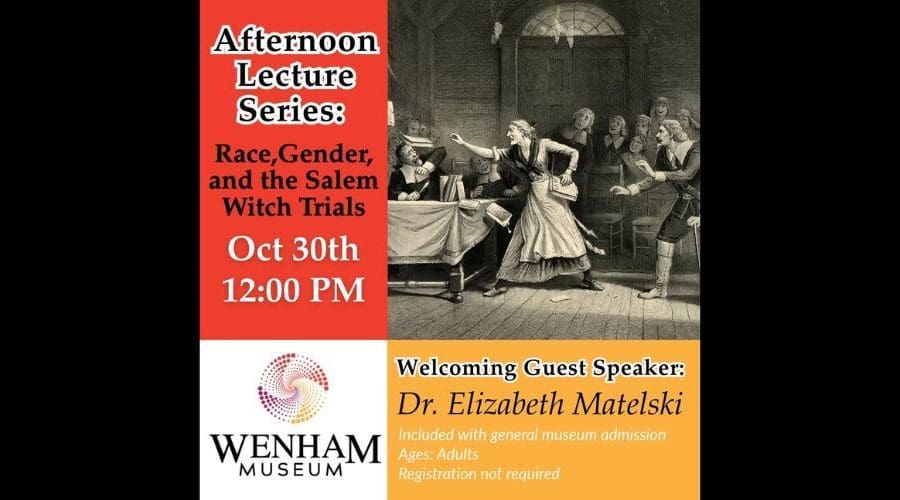
Beyond the Trials: Race, Gender, and Power in 1692
The Salem Witch Trials are often remembered as a story of fear and hysteria—but the events of 1692 were also shaped by race, gender, social status, and power. Who was accused, who was believed, and whose voices were heard?
Join Dr. Elizabeth Matelski for a thought-provoking look at the Salem Witch Trials through the lens of race and gender. Explore the lesser-known dynamics of prejudice, inequality, and power that influenced the events of 1692 and gain a deeper understanding of the people and communities behind one of the most infamous chapters in American history.
Visiting Salem this fall? Go beyond the familiar Salem Witch Trials sites and discover another North Shore connection to the story. After the lecture, be sure to explore Wenham Museum’s galleries and collections, then step inside the 1662 Claflin-Gerrish-Richards House, one of the North Shore’s earliest historic dwellings.
The house has a direct connection to the events of 1692. In November of that year, Wenham teenager Mary Herrick met there with Rev. Joseph Gerrish and Rev. John Hale, where she made accusations involving Hale’s wife and shared claims concerning the recently executed Mary Easty. The encounter helped change Hale’s view of the witchcraft proceedings. It’s a chance to experience the history where it happened and see a side of the Salem Witch Trials story that extends beyond Salem itself.
The lecture is included with general museum admission, so make a day of your visit and explore the museum before or after the program.
Dr. Elizabeth Matelski, Ph.D., is Distinguished Professor of History at Endicott College in Beverly, Massachusetts, where she teaches courses on race, gender, and sexuality in American history. She earned her A.B. from Ripon College and her Ph.D. from Loyola University Chicago. Matelski is a former director of two National Endowment for the Humanities (NEH) summer institutes focused on the Salem Witch Trials. Her current research examines the life of Robin Mingo, a formerly enslaved Black man who lived in Beverly in the early 1700s.
This makes the museum itself part of the Salem-history experience, rather than making the lecture feel like a standalone event.
Adult Event | Included with museum admission, no additional cost
Click for More Information