Learn About Black and Indigenous Figures from North of Boston’s History
April 28, 2026Poets, musicians, activists, militiamen—these Black and Indigenous leaders changed the course of local and national history. Consider these teaser biographies your invitation to learn more.
Masconomet
The sagamore of the Agawam tribe, Masconomet ruled the territory from Cape Ann to the Merrimack River. When Puritan colonists arrived in 1633, they brought with them disease that decimated the tribe. Masconomet, who survived, sold the land to John Winthrop Jr. of the Ipswich settlement. If you’re moved to pay your respects, Masconomet’s gravesite can be found on Sagamore Hill in Hamilton.
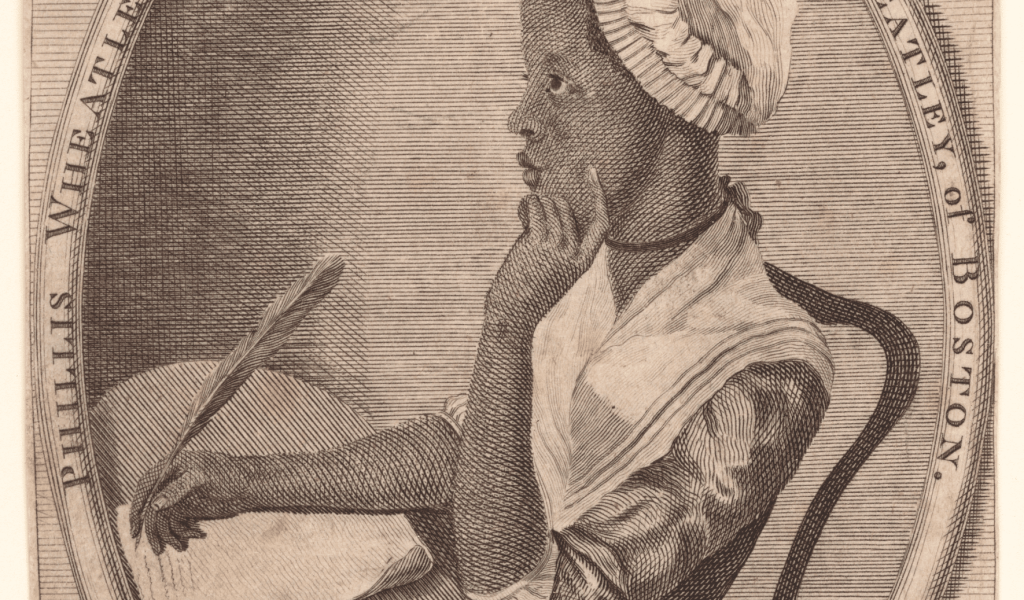
Phillis Wheatley
Born in West Africa in 1753, Phillis Wheatley was enslaved in Boston at a young age. She published her first poem, “On Messrs. Hussey and Coffin,” at age 13, and her elegy for Reverend George Whitefield, whose body still lies in a Newburyport crypt (learn more on a free Sunday tour of Old South Presbyterian Church), elevated her to national prominence. Her book of poetry was published in London, and after her tour there, she obtained her freedom.
Joseph and Lucretia Brown
The son of a Gay Head Wampanoag man and an enslaved African woman, Joseph Brown grew up in North Kingstown, Rhode Island. During the Revolution, he served in the militia and obtained his freedom. In Marblehead, he married Lucretia Brown, and the couple opened a beloved tavern on Gingerbread Hill, which still stands today as a private residence.
Joseph English
Masconomet’s grandson, Joseph English, grew up in Ipswich and served as a scout throughout the Merrimack Valley during the American Revolution. His legacy of cooperation with English colonists is the subject of Benjamin Webster’s recent Harvard thesis, which theorizes that this partnership was a strategy to deflect hostility for the sake of survival.
Charlotte Forten Grimké
After growing up in a free family in Philadelphia, Charlotte Forten Grimké moved to Salem where she continued her family’s legacy of abolitionism. A poet and women’s rights activist, she became the first Black student to enroll at Salem Normal School—today Salem State University—in 1856 and subsequently became the first Black teacher at Salem public schools.
Julian Steele
Born in Savannah, Georgia, Julian Steele moved to Boston with his family in 1915. A Harvard graduate, he directed the Armstrong Hemenway Foundation and supported affordable-housing efforts. The first Black Massachusetts Congregationalist moderator and first Black town moderator in the state, he is honored with a historic marker in front of West Newbury’s town hall.
Roland Hayes
The lyric tenor of a generation, Roland Hayes cut his teeth with Fisk University’s Jubilee Singers, and he stayed in Boston after visiting on tour. Not only did he sing for England’s King George V in 1921, but he also became the first African American soloist to perform with the Boston Symphony Orchestra. With the support of Julian Steele, he decided to purchase a summer home in West Newbury, where he often put on community concerts. Recordings online allow you to listen to his sweet tones as you explore this town on the Merrimack River.
Manuel’s Black and White Orchestra
Founded in Beverly in 1916 by Otis Alvin Manuel Jr. and David Manuel, Manuel’s Black and White Orchestra was one of the first racially integrated bands in the country. Performing swinging jazz in snazzy tuxedos, they shared the stage with Duke Ellington and the Dorsey Brothers. The band continued to entertain until 2008.
Photo: portrait of Phillis Wheatley, National Portrait Gallery, Smithsonian Institution
*
This blog is an excerpt from our digital guide “250 Ways to Explore, Discover, and Celebrate North of Boston”. To view the full guide, click here.